Why a piece is sized to the room around it, not to itself.
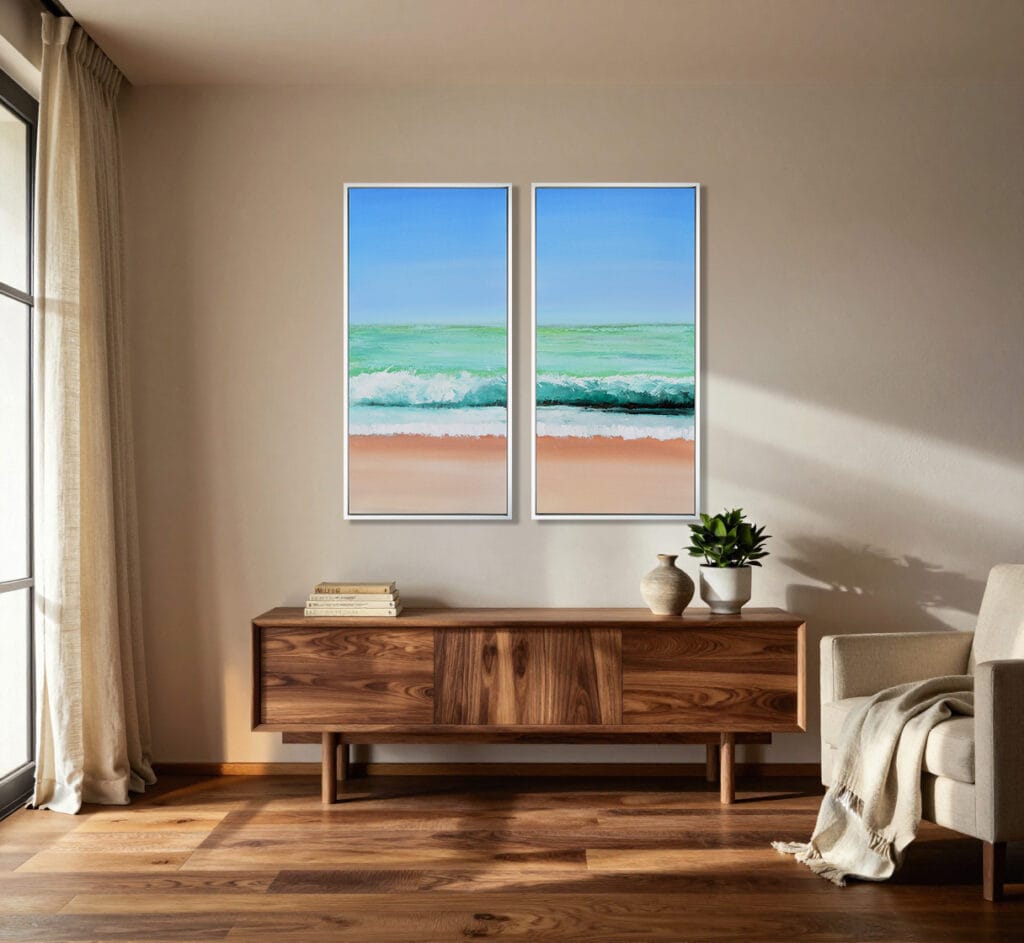
When a piece feels wrong on a wall, it’s usually not the piece — it’s the scale. Size isn’t a fixed quality of the work. It’s a relationship with everything around it.
A piece is read against the things near it: the sofa beneath, the doorway beside, the width of the wall itself. Over a long sofa, a small work looks lost. Over a narrow console, a large one looms.
The goal isn’t the biggest piece the wall can hold. It’s the size that lets the wall, the furniture, and the work settle into one calm picture.
A useful starting point, from hanging a lot of walls: a piece over furniture reads best at roughly two-thirds the width of what’s below it. Wider than the furniture and it feels top-heavy; much narrower and it floats.
But that’s a guide, not a law. The real test is whether the wall reads as one image, or as separate parts competing for attention.
Size the piece to the company it keeps, not to itself.
In your home
Let the furniture set the size,
then test it from across the room.
Scale isn’t about the piece alone — it’s how it sits with everything around it.
Size it to the company it keeps, and the wall reads as one.
With care Bonum Studio