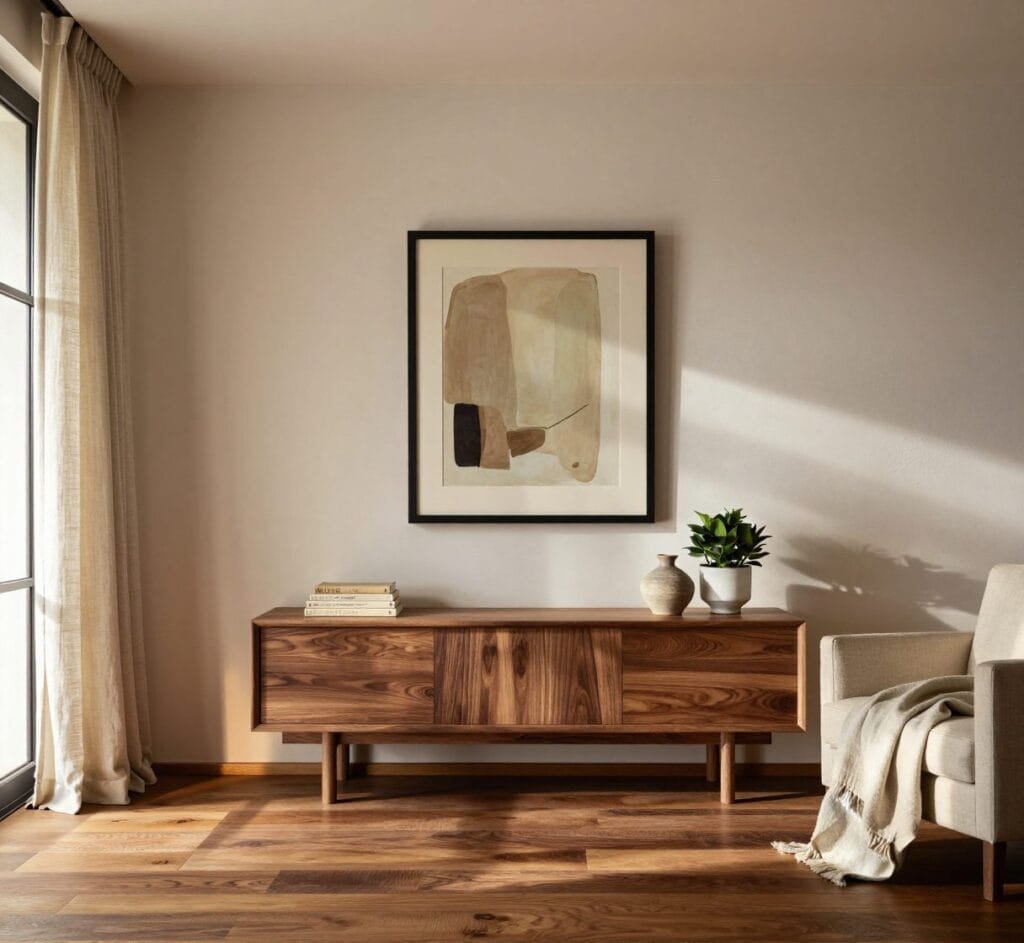
You chose the work for what it is. But a painting is never only the painting — it is the painting under the particular light of the room it lives in. That light is not a finishing detail. It is part of the work itself.
Light is not something you add to a painting. It is what finishes it.
Two homes can receive the same piece and live with two different works. One hangs it where the morning enters from the side, and the surface wakes — the brushwork lifts, the edges breathe. The other hangs it under a flat ceiling light, straight on, and the same surface goes quiet and even. Nothing changed but the angle of the light.

This is the part most people resolve by accident, and then wonder why a piece they loved in the gallery feels muted at home. The gallery was lit to reveal. A living room rarely is — unless you decide it.
Place the work where the day moves across it, and you will never live with the same painting twice.
A surface that changes from morning to evening is not a flaw to correct. It is the work staying alive in your house — answering the hour, the season, the weather outside the window. The piece becomes something you keep meeting, rather than something you stop seeing.
In your home
When the light is right, you stop seeing the frame and begin to see the work.
With care Bonum Studio